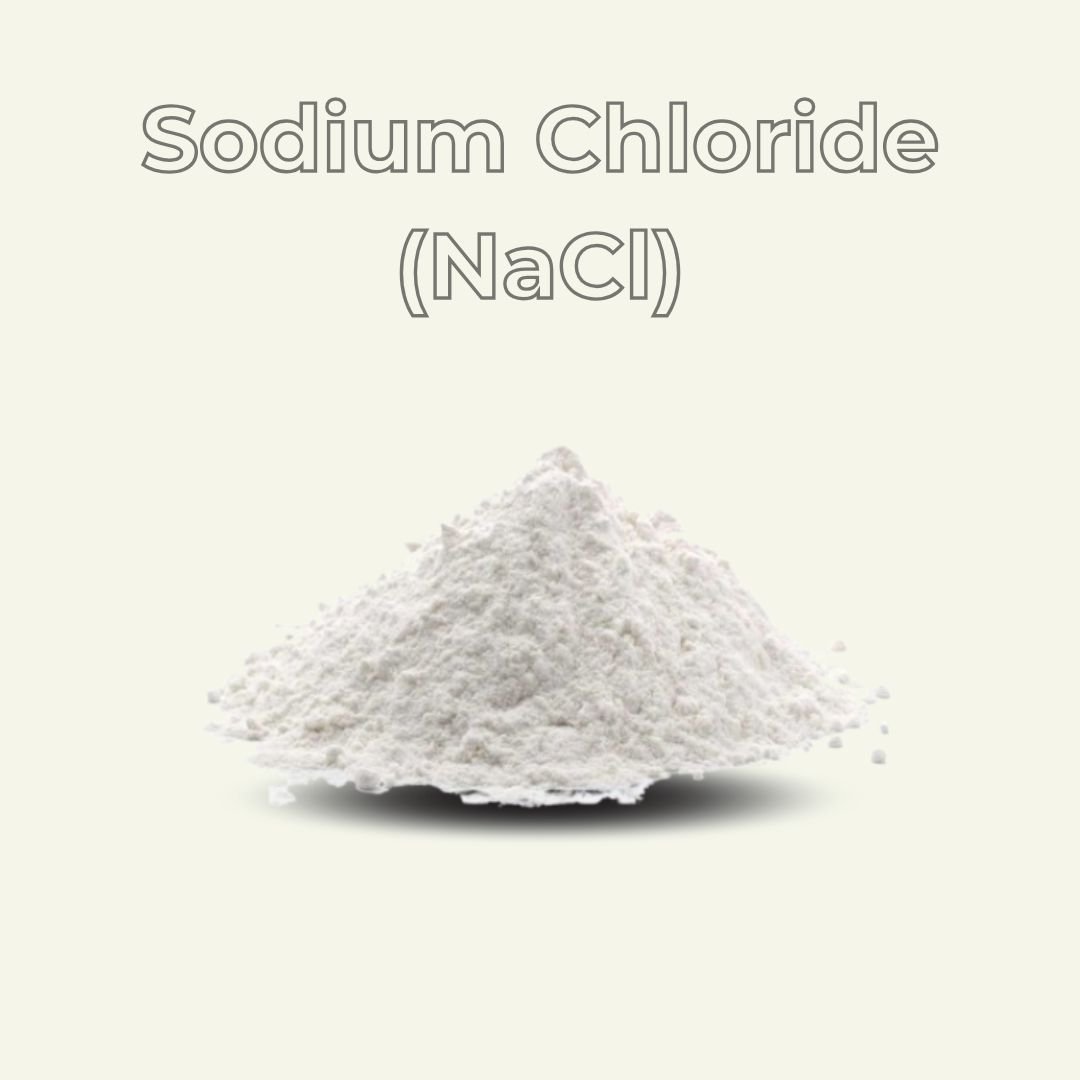
Product: Sodium Chloride
Rchem Sodium Chloride is a high-purity, crystalline inorganic salt, presented as white, free-flowing crystals or fine powder. Commonly known as table salt or common salt, it is a naturally occurring mineral composed of sodium and chlorine ions (NaCl). Renowned for its exceptional ability to increase the viscosity of surfactant-based systems, act as a thickening agent, and provide preservative-boosting properties, it is a cornerstone ingredient in the cosmetic, personal care, pharmaceutical, and food industries for viscosity control, isotonicity adjustment, and preservation enhancement.
Categories: Acid Thickeners and Functional Ingredients, Core
Category: powder
Description
Key Features & Benefits:
Technical Specifications Table:
Property
Detail
Apperance
Scent
Solubility
Uses
pH
Charge
Used In
Usage Rate
Product Origin
PALM DERIVATIVES STATUS
VEGAN SUITABLE
Chemical Formulae
Frequently Asked Questions:
How does Sodium Chloride thicken shampoos and body washes?
Sodium chloride thickens anionic surfactant systems (such as SLES, SLS, ALS) through a mechanism known as "salting out" or micellar growth. When salt is added to an aqueous surfactant solution, the sodium (Na+) and chloride (Cl-) ions interact with the water molecules. This reduces the water's ability to hydrate the surfactant head groups. As a result, surfactant molecules pack more closely together, forming larger micelles. These larger micelles increase the viscosity (thickness) of the solution. However, there is a peak point – adding too much salt will cause the micelles to become too large and separate, leading to a sudden drop in viscosity (salting out).
This occurs because you have exceeded the salt peak or salting-out threshold. The relationship between salt concentration and viscosity follows a bell curve: (1) Low salt → Low viscosity; (2) Increasing salt → Viscosity increases; (3) Optimum salt → Maximum viscosity; (4) Excess salt → Viscosity drops sharply, and the product may become cloudy or separate into layers. If this happens, simply dilute with additional water or unsalted surfactant base to bring the salt concentration back below the threshold.
Why does my shampoo sometimes get thinner when I add more salt?
The optimal salt concentration varies depending on the surfactant system, total active matter, and presence of other ingredients. General guidelines for a typical SLES/CAPB shampoo system (12-15% total active matter): Starting point: 0.5% - 1.0% Sodium Chloride Typical range: 0.5% - 2.5% Method: Add salt slowly (e.g., 0.1% increments), mixing thoroughly, and measure viscosity after each addition. Different salt concentrations may be required for different surfactant ratios and desired end viscosity. Important: Always add salt after all other ingredients are fully dissolved and the batch is uniform. Salt should be added as a solution (20-25% NaCl in water) rather than as dry crystals to ensure complete dissolution and avoid localized over-salting.
What is the recommended salt concentration for thickening shampoos?
No. Sodium chloride is an effective thickener only for anionic surfactant systems (e.g., SLES, SLS, ALS). It does not thicken: Non-ionic surfactant systems (e.g., Polysorbates, Decyl Glucoside) Amphoteric surfactant systems alone (e.g., CAPB alone – but CAPB/SLES blends respond to salt) Cationic surfactant systems (e.g., hair conditioners) Emulsions (creams/lotions – salt may actually thin or destabilize them) Polymer-thickened systems (e.g., Carbomer gels – salt will cause viscosity loss) For these systems, alternative thickeners (fatty alcohols, gums, cellulose derivatives, carbomers) are required.
Can Sodium Chloride be used in all types of formulations as a thickener?
Handling: Sodium chloride is a free-flowing crystalline powder. Use appropriate PPE including a dust mask, gloves, and safety goggles if handling large quantities. Avoid inhalation of dust. Formulation – Adding to Shampoos/Body Washes: (1) Prepare a 20-25% salt solution in water (pre-dissolved); (2) Add the salt solution slowly (0.1-0.2% increments) to the finished surfactant base; (3) Mix thoroughly for 5-10 minutes after each addition; (4) Measure viscosity and continue adding until target viscosity is reached; (5) Adding salt to the water phase at the beginning of manufacturing often results in consistently lower final viscosity than adding at the end – post-addition is preferred for precise control. Troubleshooting: If the product becomes cloudy or separates (salting out), dilute with water or unsalted base. Storage: Store in a cool, dry place in tightly sealed containers. Sodium chloride is hygroscopic – it will absorb moisture from humid air, potentially causing caking. Shelf life is virtually indefinite under proper storage (5+ years). Always refer to the Safety Data Sheet (SDS) for comprehensive handling, safety, and first-aid information.