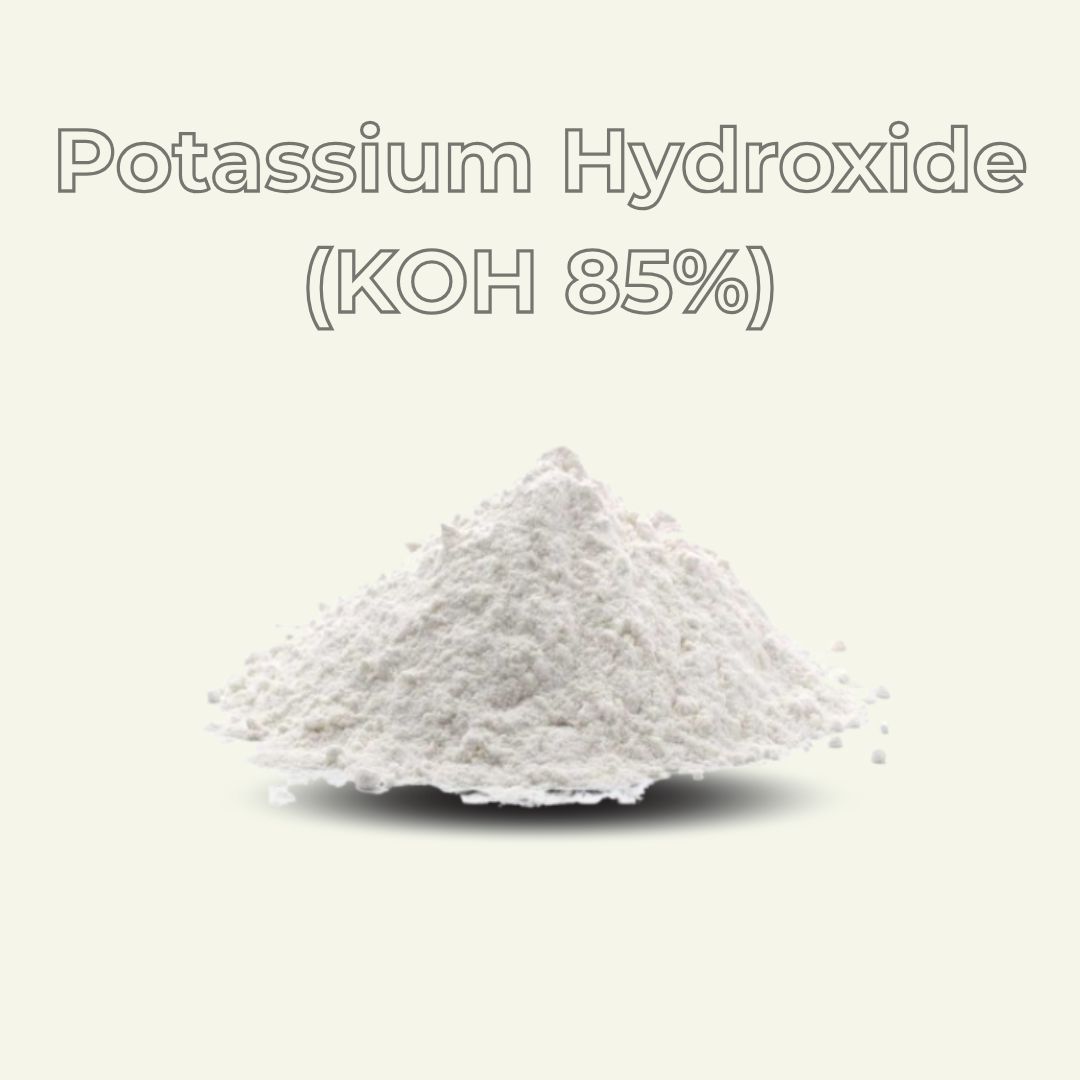
Rchem Potassium Hydroxide (KOH) 85% is a high-purity, inorganic alkaline compound, presented as white to slightly off-white flakes, pellets, or lumps. This powerful base, commonly known as caustic potash, is renowned for its strong alkalinity, excellent solubility in water, and its ability to react with fatty acids to form soft soaps. It is a cornerstone ingredient in the manufacture of liquid soaps, detergents, biodiesel, and a wide range of industrial processes requiring a strong, water-soluble alkal
Rchem is a leading supplier of premium-quality Potassium Hydroxide 85% in Pakistan, providing a reliable and highly effective alkali for diverse industrial and cosmetic applications. Our product is valued for its high purity (85% minimum KOH content), consistent quality, and rapid solubility in water and alcohols. It is the preferred base for producing liquid soap pastes (potassium soaps) due to the exceptional clarity and soft, creamy texture of the resulting product. Trusted by manufacturers across Karachi, Lahore, and Islamabad, our KOH 85% ensures your soaps, cleaning agents, and industrial chemicals achieve desired saponification and pH levels. Rchem is your trusted partner for high-performance alkaline solutions.
Key Features & Benefits:
Powerful Alkali & pH Adjuster: Provides strong alkalinity for effective pH adjustment in cosmetic, industrial, and water treatment applications. Superior Saponification Agent: Reacts with fatty acids and oils to form water-soluble potassium soaps, producing liquid soaps, soft soaps, and soap pastes with excellent clarity and creamy texture. Excellent Solubility in Water & Alcohols: Dissolves rapidly and completely in water, generating significant heat (exothermic reaction) and producing highly alkaline solutions. Effective Cleaning & Degreasing: Used in heavy-duty industrial cleaners, degreasers, and metal cleaning formulations for its powerful ability to break down fats, oils, and greases. Versatile Industrial Chemical: Essential in biodiesel production (as a catalyst), food processing (as a pH adjuster and peeling aid), and chemical manufacturing (as a precursor for potassium salts). Cost-Effective & High Purity: Provides consistent performance and high reaction efficiency at a competitive price point.
Technical Specifications Table:
Property
Detail
Apperance
White to slightly off-white flakes, pellets, or lumps
Scent
Odorless
Solubility
Highly soluble in water (exothermic), alcohols, and glycerol
Uses
Saponification agent, pH adjuster, cleaning agent, catalyst, chemical intermediate
pH
13.5 – 14.0
Charge
Anionic (dissociates into K⁺ and OH⁻ ions in solution)
Stoichiometric calculation based on saponification value (typically up to 100% of required lye in liquid soap formulations)
Product Origin
Industrial (Electrolysis of Potassium Chloride)
PALM DERIVATIVES
STATUS
Palm-Free
VEGAN SUITABLE
Yes
Chemical Formulae
KOH
Frequently Asked Questions:
What is the primary difference between Potassium Hydroxide (KOH) and Sodium Hydroxide (NaOH/Caustic Soda) in soap making?
The key difference is the type of soap produced. KOH produces soft, paste, or liquid soaps (potassium soaps) that are water-soluble, produce a creamy lather, and are ideal for liquid hand soaps, shampoos, and shaving creams. NaOH produces hard, bar soaps (sodium soaps) that are solid at room temperature and ideal for bath bars and laundry soaps. KOH creates soaps with higher solubility and a softer texture.
KOH is extremely hygroscopic and readily absorbs moisture from the atmosphere. The 85% concentration represents a stable, commercially practical form that balances high activity with manageable handling characteristics. Higher concentrations (e.g., 90-95%) are possible but are more prone to absorbing moisture and forming clumps, making them difficult to handle and weigh accurately. The 15% water content in 85% KOH is water of hydration that contributes to the reaction.
Why is 85% concentration specified instead of 100%?
When using 85% KOH, you must account for the purity. The formula is: Amount of KOH 85% required = (Theoretical 100% KOH weight) ÷ 0.85 For example, if your formulation calls for 100g of 100% KOH, you would need: 100g ÷ 0.85 = 117.65g of KOH 85% Always use a soap calculator or perform precise stoichiometric calculations based on the saponification value (SAP value) of your specific oils.
How do I calculate the correct amount of KOH 85% for saponification?
KOH is a highly caustic and corrosive substance. It can cause severe chemical burns to skin and eyes, and inhalation of dust or mist can cause serious respiratory damage. Always use appropriate personal protective equipment (PPE): chemical-resistant gloves, safety goggles or face shield, protective clothing, and respiratory protection when dust is present. Always add KOH to cold water (never water to KOH), as the dissolution generates significant heat and can cause violent boiling or splattering. Always refer to the Safety Data Sheet (SDS) for comprehensive safety and first-aid measures.
Is Potassium Hydroxide safe to handle?
Store in a cool, dry, well-ventilated area in tightly sealed, corrosion-resistant containers (HDPE or polypropylene). Keep containers away from moisture, acids, and incompatible materials (e.g., aluminum, zinc, tin, and other reactive metals). Because KOH is highly hygroscopic, any exposure to air will cause it to absorb moisture, become sticky, and form clumps or cakes, reducing its effectiveness. Always reseal containers immediately after use.
What are the key storage recommendations for KOH 85%?