Product: Ceteareth-20
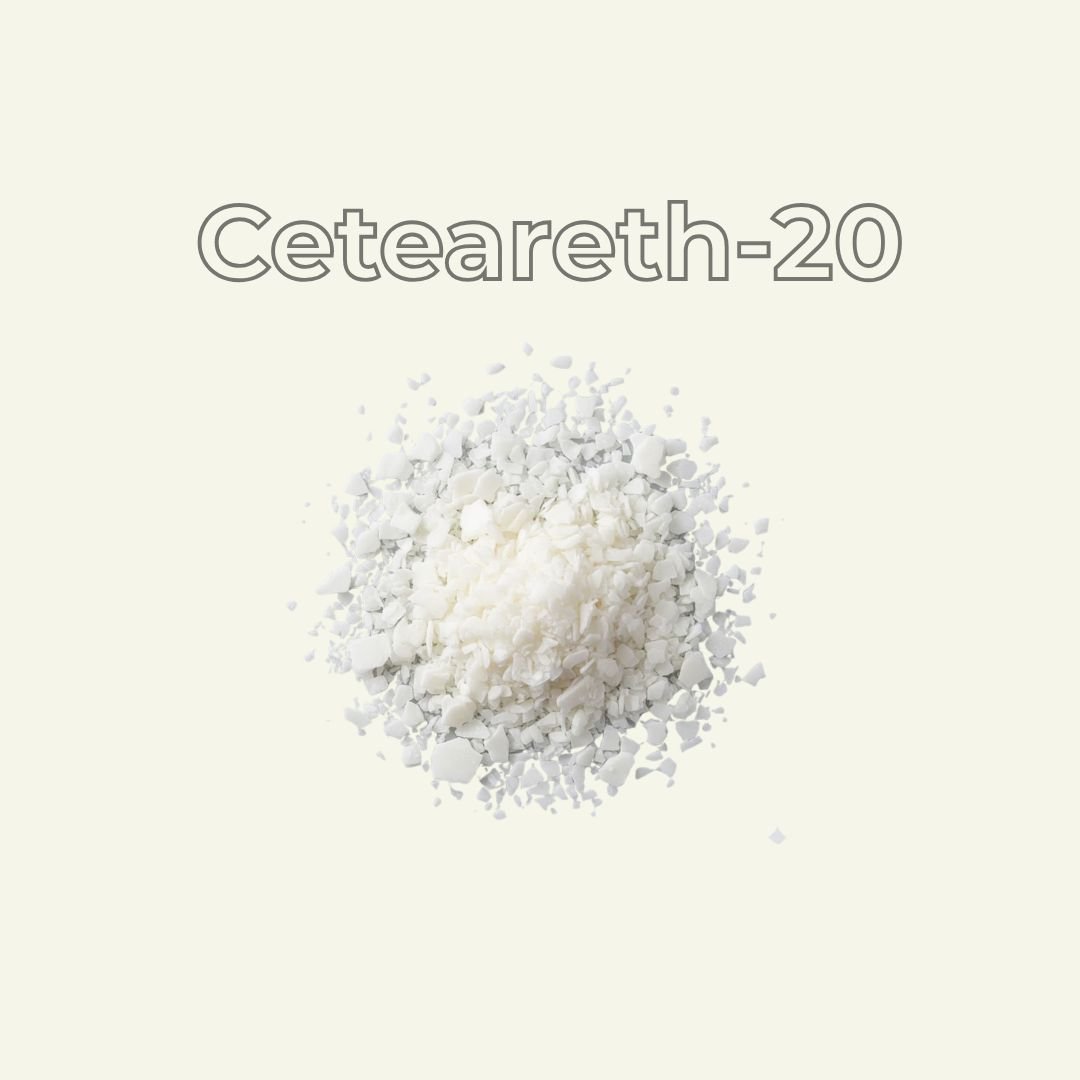
Rchem Ceteareth-20 is a high-purity, non-ionic surfactant and emulsifier, typically presented as a white to off-white waxy solid or flakes. It is a polyethylene glycol ether of cetearyl alcohol (a mixture of cetyl and stearyl alcohols), with an average of 20 moles of ethylene oxide (EO). Renowned for its high hydrophilic-lipophilic balance (HLB approximately 15.2-15.7), it is a cornerstone ingredient in the cosmetic and pharmaceutical industries for producing stable, elegant oil-in-water (O/W) emulsions, particularly in creams, lotions, and ointments requiring a smooth, non-greasy finish.
Categories: Co-Emulsifiers
Category: powder
Description
Key Features & Benefits:
Technical Specifications Table:
Property
Detail
Apperance
Scent
Solubility
Uses
pH
Charge
Used In
Usage Rate
Product Origin
PALM DERIVATIVES STATUS
VEGAN SUITABLE
Chemical Formulae
Frequently Asked Questions:
What is the difference between Ceteareth-20 and Cetearyl Alcohol?
This is a critical distinction. Cetearyl Alcohol is a fatty alcohol that functions as an emollient, thickener, and co-emulsifier but is not a primary emulsifier on its own. Ceteareth-20 is the ethoxylated version of Cetearyl Alcohol, making it water-soluble and giving it the high HLB necessary to function as a primary O/W emulsifier. They are often used together as a pair (self-emulsifying wax), where Ceteareth-20 emulsifies and Cetearyl Alcohol adds body, stability, and a smooth skin feel.
Ceteareth-20 can be used alone as a primary O/W emulsifier and will produce stable emulsions. However, for optimal stability, texture, and skin feel, it is almost always used in combination with a lipophilic co-emulsifier, typically Cetearyl Alcohol or other fatty alcohols. The classic "self-emulsifying wax" is a blend of approximately 80-90% Cetearyl Alcohol and 10-20% Ceteareth-20, which provides both emulsification and emulsion stability in one convenient ingredient.
Can Ceteareth-20 be used alone as an emulsifier, or does it need a co-emulsifier?
Ceteareth-20 is generally considered safe and mild for topical use. It is non-ionic, which is less likely to cause irritation compared to ionic emulsifiers. However, as an ethoxylated ingredient, there is a theoretical concern about residual 1,4-dioxane or ethylene oxide, but reputable manufacturers utilize purification processes (vacuum stripping) to reduce these impurities to trace, safe levels. For extremely sensitive skin, non-ethoxylated alternatives like glyceryl stearate or cetearyl olivate may be preferred. Patch testing is always recommended.
Is Ceteareth-20 safe for use on sensitive skin?
HLB (Hydrophilic-Lipophilic Balance) is a scale from 0-20 indicating an emulsifier's preference for water (high HLB) or oil (low HLB). An O/W emulsion typically requires emulsifiers with HLB values between 8-18. Ceteareth-20's HLB of ~15.5 makes it suitable for emulsifying a wide range of oils with Required HLB values typically between 12-15. It can also be blended with lower HLB emulsifiers (e.g., Glyceryl Stearate, HLB ~3.8) to match the exact Required HLB of a specific oil phase, achieving maximum stability.
What is the concept of HLB, and why is Ceteareth-20's HLB of ~15.5 important?
Handling: Ceteareth-20 is a waxy solid/flakes at room temperature. Use appropriate PPE including gloves and safety goggles. Melt the flakes by heating to 60-70°C (140-158°F) before incorporation. Formulation: For O/W emulsions, melt Ceteareth-20 along with the oil phase and any low-HLB co-emulsifiers. Heat the water phase to the same temperature (70-75°C / 158-167°F). Gradually add the water phase to the oil phase with high-shear mixing, then cool slowly with gentle stirring. Storage: Store in a cool, dry place in tightly sealed original containers to prevent moisture absorption. Protect from extreme heat. Shelf life is typically 24-36 months under proper storage. Always refer to the Safety Data Sheet (SDS) for comprehensive handling, safety, and first-aid information.