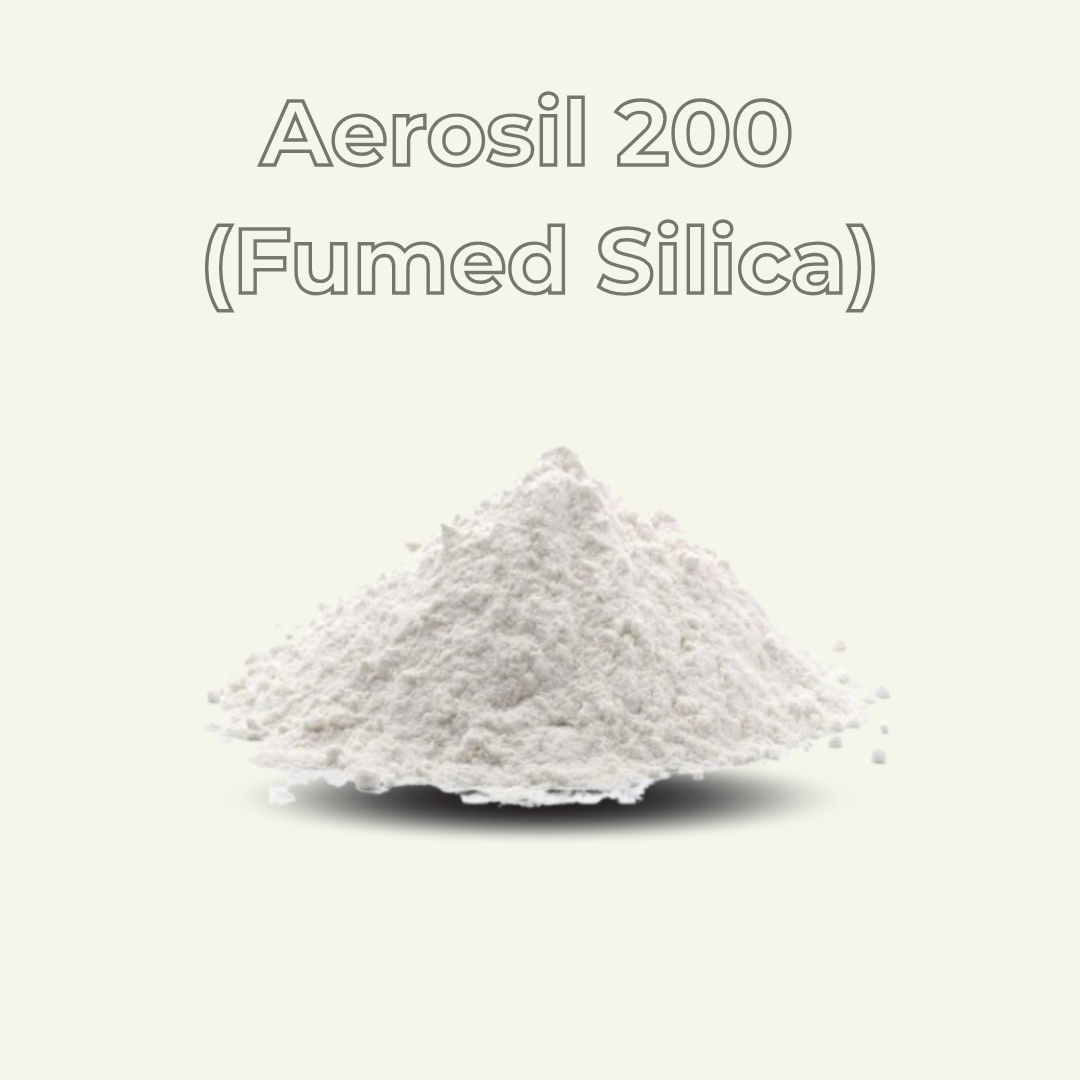
Rchem Aerosil® 200 is a high-purity, hydrophilic fumed silica, presented as a white, fluffy, nanoscale powder. This versatile synthetic amorphous silicon dioxide is produced in a flame hydrolysis process, resulting in an extremely high surface area and a three-dimensional branching chain structure. Renowned as one of the most effective rheology modifiers and thixotropic agents available, it is indispensable for controlling viscosity, preventing sagging, and suspending solids in a vast array of liquid systems.
Rchem is a leading supplier of Aerosil® 200 in Pakistan, providing a fundamental ingredient for advanced formulations in the coatings, adhesives, sealants, cosmetics, and food industries. Its primary function is to form a hydrogen-bonding network throughout a liquid, creating a semi-rigid structure that provides anti-settling and thickening effects. This structure is reversible under shear stress (thixotropy), allowing for easy application before it thickens again at rest. Trusted by formulators across Karachi, Lahore, and Islamabad, our Aerosil® 200 ensures your products have the desired body, stability, and performance. Rchem is your reliable partner for high-performance specialty chemicals.
Key Features & Benefits:
Powerful Thixotropic Thickener: Provides strong viscosity build and anti-sag properties in paints, adhesives, and gels, preventing settling and dripping on vertical surfaces. Excellent Suspending Agent: Effectively suspends pigments, fillers, and other solid particles in liquids, ensuring product homogeneity. Reinforcing Filler: Significantly improves the tensile strength, tear resistance, and mechanical properties of silicone elastomers and other polymers. High Surface Area & Purity: Its extremely fine particles and high purity (≥99.8%) make it highly effective at low usage levels. Free-Flow Aid: Prevents caking and improves the flowability of powdered products. Matting Agent: Can be used to control gloss in coatings and films.
Technical Specifications Table:
Property
Detail
Apperance
White, fluffy, ultra-fine powder
Scent
Odorless
Solubility
Insoluble in water and organic solvents; forms a colloidal dispersion
Uses
Thickening agent, thixotrope, suspending agent, reinforcing filler, free-flow aid
It thickens through the formation of a three-dimensional network. The tiny silica particles have surface silanol (Si-OH) groups that form hydrogen bonds with each other, creating a chain-like structure throughout the liquid. This network traps the liquid medium, dramatically increasing viscosity and providing yield value (resistance to flow until a certain stress is applied).
Thixotropy is a time-dependent shear-thinning property. A thixotropic material is viscous at rest (preventing sag and settling) but becomes thin and fluid when shaken, stirred, or brushed (for easy application). Once the shear force is removed, the material regains its viscosity over time.
What does "thixotropy" mean?
To achieve a lump-free dispersion: High-Shear Mixing: Use a high-shear mixer (like a disperser) and sprinkle the powder slowly into the vortex of the liquid. Pre-dispersion: Pre-mix the Aerosil with a non-solvent (like a portion of the liquid resin or a plasticizer) to form a paste before adding it to the main batch. Avoid Low-Shear Mixing: Simple stirring is insufficient and will lead to the formation of persistent "fish-eyes" or lumps.
What is the best way to incorporate Aerosil® 200 into a formulation to avoid lumps?
Hydrophilic Aerosil (like A200) has polar silanol groups on its surface, making it ideal for water-based and polar solvent systems. Hydrophobic Aerosil is surface-treated with silanes to make it water-repellent, making it ideal for non-polar systems (like silicone oils or epoxy resins) where moisture resistance is critical.
What is the difference between hydrophilic (e.g., A200) and hydrophobic Aerosil?
No, this is a critical distinction. Aerosil® 200 is amorphous silica, meaning its atoms are not arranged in a regular, crystalline pattern. It is chemically inert and safe for its intended uses. Crystalline silica (e.g., quartz), in its respirable dust form, is a known occupational health hazard. Aerosil is non-crystalline.